Most companies plan incentive trips around destination, budget, and attendee appeal.
But what if the calendar itself became part of the value proposition?
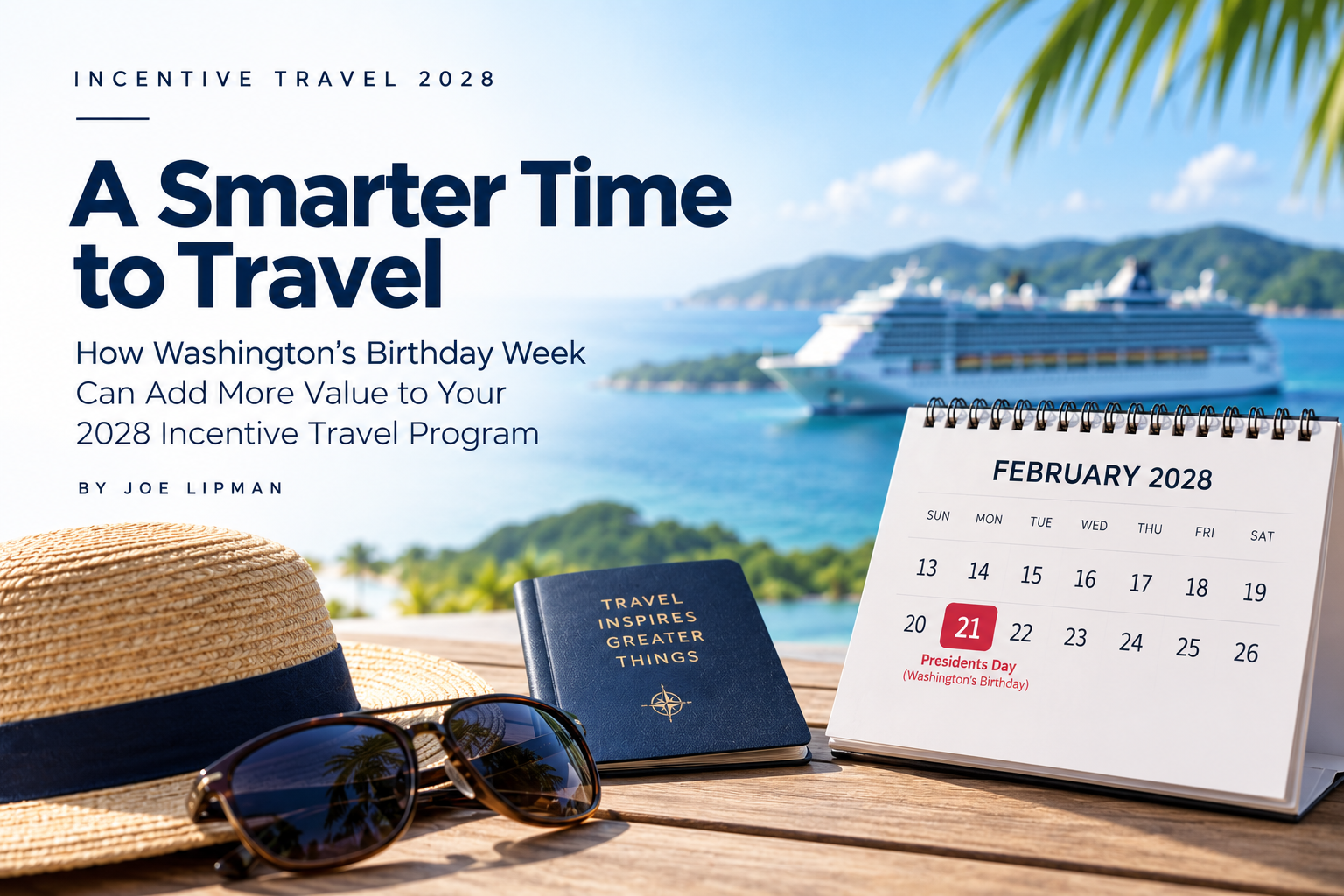
As organizations begin looking ahead to 2028 incentive travel programs, Washington's Birthday Week presents a unique opportunity that deserves consideration. With Presidents Day falling on Monday, February 21, 2028, companies have an opportunity to leverage a holiday that employees already have off while creating a longer and more memorable travel experience.
Traditionally, many incentive programs operate on a Wednesday-to-Monday schedule. While effective, these programs often require attendees to take additional time away from work and family commitments.
A Washington's Birthday Week program changes the equation.
By departing over the holiday weekend, participants can take advantage of a federal holiday that is already built into the calendar. In many cases, schools and businesses are closed on Monday, reducing the impact of time away from the office while creating the opportunity for a longer travel experience.
For family-oriented programs, this can be especially attractive. Some school districts may have additional days off during that week, making travel easier for families. Even when they do not, the holiday still provides a natural launching point for a program.
The result is a full seven-night experience that often feels easier to justify than a traditional week-long trip because part of the schedule is already supported by the holiday calendar.
Looking Beyond Traditional Resort Programs
Many organizations automatically focus on land-based Caribbean resorts when evaluating incentive travel. While resorts remain excellent options, cruise programs deserve a closer look than they often receive.
Today's cruise ships are destinations unto themselves.
Guests can enjoy multiple dining venues, entertainment options, private islands, shore excursions, meeting facilities, networking opportunities, spas, fitness centers, and accommodations ranging from standard staterooms to luxury suites.
Perhaps most importantly, a cruise creates a shared experience. Attendees travel together, dine together, participate in activities together, and build relationships in a way that can be difficult to replicate in a traditional resort setting.
Three Distinct Approaches
Family-Friendly Value: Royal Caribbean
A seven-night sailing from Cape Liberty, New Jersey offers a compelling combination of convenience and value.
The ability to drive to the port eliminates airfare costs entirely. Guests can enjoy a full Caribbean itinerary while spouses, children, and extended family members can participate through triple and quad occupancy accommodations.
For organizations seeking maximum participation, this approach can be particularly attractive.
Adults-Only Recognition Programs
For companies focused on owners, managers, key customers, strategic suppliers, and top performers, adults-only cruise programs offer a very different atmosphere.
Virgin Voyages has created a modern, upscale experience centered around exceptional dining, contemporary entertainment, and sophisticated accommodations. These programs can work particularly well for recognition programs, relationship-building events, and executive-level travel.
Destination-Focused Caribbean Experiences
Longer Southern Caribbean itineraries offer access to destinations such as Aruba, Curaçao, Antigua, St. Maarten, Puerto Rico, and other Caribbean favorites.
Rather than remaining in a single resort, attendees experience multiple destinations while enjoying the convenience of unpacking only once.
Regional Departure Options Expand the Opportunity
While a Cape Liberty departure works exceptionally well for organizations located in the Northeast, companies based in other regions of the country have similar opportunities available from ports closer to home.
Organizations located in the Southeast can take advantage of departures from Miami, Fort Lauderdale, Port Canaveral, Tampa, Jacksonville, Charleston, Mobile, Galveston, and New Orleans.
West Coast organizations have access to sailings from Los Angeles, Long Beach, San Diego, San Francisco, and Seattle, offering itineraries to Mexico, the Pacific Coast, Alaska, Hawaii, and beyond.
Companies located in Texas benefit from convenient departures from Galveston, one of the fastest-growing cruise ports in North America, while Midwestern organizations often find that flights to Florida, Texas, or New Orleans are both plentiful and competitively priced.
The key advantage is flexibility.
Unlike many land-based incentive programs that require participants to fly into a single destination, cruise programs provide numerous embarkation options throughout the United States. This often reduces airfare costs, minimizes travel time, and creates more convenient options for attendees and their families.
In many cases, the savings in airfare and transfers can offset a meaningful portion of the program cost while still delivering a premium incentive experience.
When evaluating a 2028 incentive program, organizations should not focus solely on the cruise itself. They should evaluate the entire travel experience from the participant's front door to the destination and back home again.
Sometimes the most cost-effective and attendee-friendly solution is simply choosing the right departure port.
The Real Value
When evaluating incentive travel, many organizations focus exclusively on the upfront cost.
A better approach is to evaluate overall value.
What is included?
How much travel time is required?
How much time must participants spend away from work?
How easy is it for spouses and families to participate?
How memorable is the experience?
Will participants still be talking about it years later?
Washington's Birthday Week offers an opportunity to answer those questions differently than traditional programs.
By combining a federal holiday, attractive destinations, and thoughtfully designed travel experiences, organizations may discover opportunities that provide greater value than they initially expected.
The best incentive programs are not simply trips.
They are experiences that strengthen relationships, reward performance, create memories, and motivate future success.
Sometimes the smartest opportunity is not changing the destination.
It's changing the way we think about the calendar.
Now is the time to begin evaluating 2028 opportunities. The best space, best pricing, and best itineraries will be secured well in advance. Organizations that plan early often gain the greatest advantage.