
A Real-Time Case Study (Part Two)
Part One laid the groundwork: how a trip can begin to unravel before most people realize anything is wrong — and why the reason for a disruption matters more than the disruption itself.
Part Two is about what happens after the clock starts ticking.
Early Morning: Silence, Then a Notice
As the morning unfolded, information remained scarce. No direct communication from the cruise line. No clear airline guidance. Clients and agents were left piecing together fragments from multiple sources — airline apps, airport screens, news coverage, and rumor.
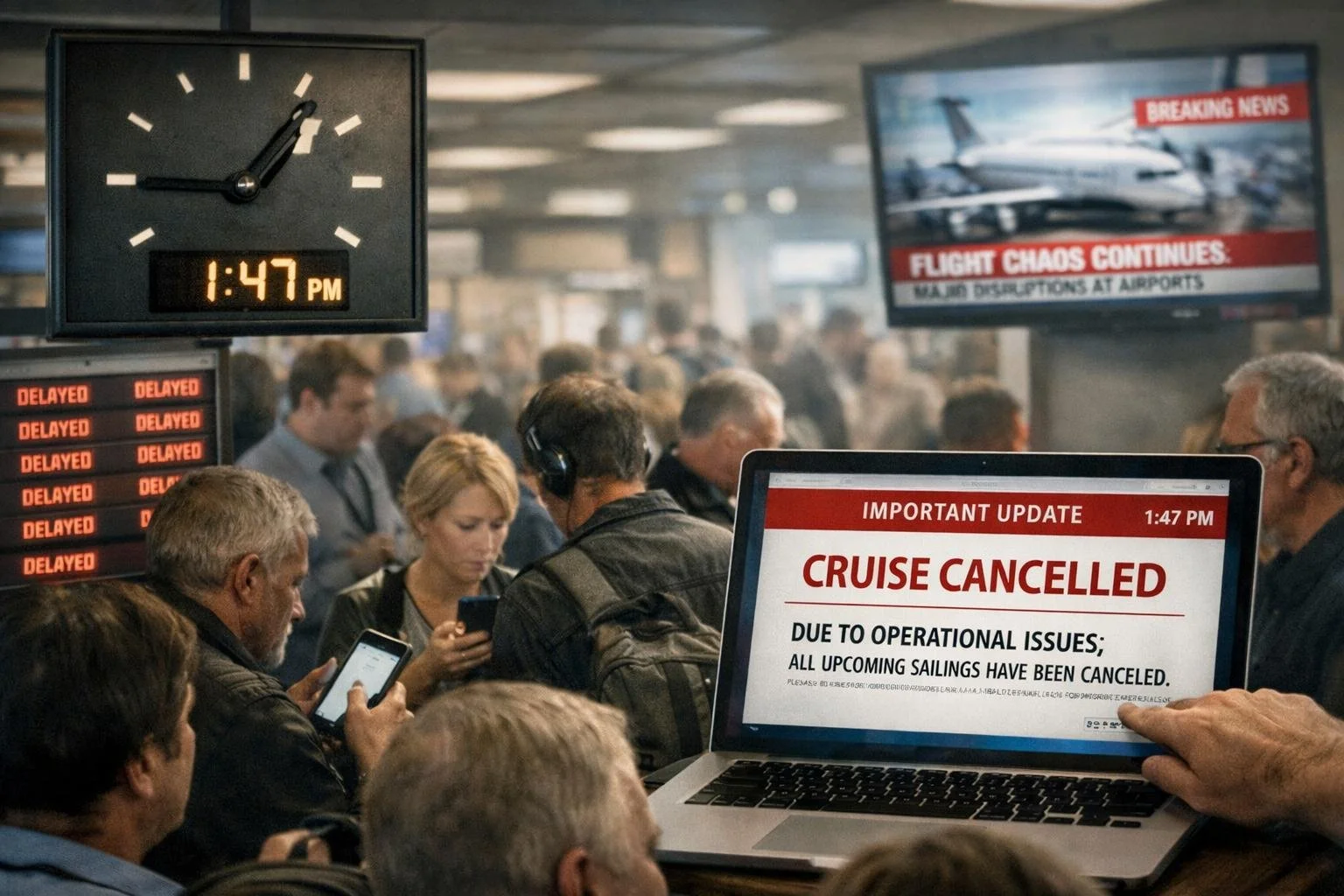
Then, at approximately 1:47 p.m., a notice finally appeared on the cruise line’s website.
The update stated that the ship would remain in port for an additional two days.
What it didn’t say was just as important:
• It did not suggest guests should plan to arrive late
• It did not offer guidance on revised embarkation
• It did not provide a live contact
• The only recommendation was to contact the insurer (AON)
At that point, we were dealing with two completely separate entities operating independently — the cruise line and the insurance provider — neither coordinating with the airlines.
And then there was the airline layer.
Airlines: Noncommittal, Fragmented, and Changing
By mid-day, airline information was inconsistent and evolving:
• Delta (original carrier from JFK)
• Service not expected to resume until at least Tuesday
• Flights routed only through Atlanta on select days
• United (daily service)
• Airport screens showed no flights Sunday, Monday, or Tuesday
• No reliable rebooking options presented
• Miami as an alternate gateway
• Flights eventually appeared late Sunday afternoon
• Fares exceeded $1,300 per person one way, making them impractical
• Cost approached the price of the cruise itself
The natural next question arose:
Would insurance cover a last-minute reroute at that cost?
Insurance Reality: Cruise vs. Air
Here’s where a critical detail mattered.
The guest had purchased cruise insurance only, not air insurance.
• The cruise policy applied strictly to the cruise components
• There was no insurance coverage for airfare
• The airline, having canceled the flights, refunded the tickets — and exited the situation entirely
From the airline’s perspective, the issue was resolved.
From the traveler’s perspective, the trip was collapsing.
The Decision Point
As the day wore on, availability began to reappear — but too late.
By the time flights started populating again late Sunday afternoon, the client had already made the decision not to travel at all. The uncertainty, the lack of guidance, the escalating costs, and the absence of a clear path forward made the decision unavoidable.
She formally advised the cruise line that she was canceling completely.
At that point, the central question became:
Will the cruise line honor the cancellation, given that the cruise ultimately sailed?
Because the guest purchased the highest-level insurance offered, we are confident this will not present an issue — but that determination rests with the insurer after full documentation.
Late Sunday: The Irony
Ironically, by late Sunday afternoon:
• United’s nonstop to Barbados operated with approximately 23 empty seats
• Delta reinstated JFK–Atlanta–Barbados service
• Miami connections became available Sunday night, Monday, and Tuesday — though still cost-prohibitive
But the decision had already been made. Delta tickets were canceled. The guest was no longer traveling.
This is the uncomfortable truth of disruption:
availability returning does not undo the damage caused by silence earlier in the day.
Why Documentation Matters
The guest contacted AON (policy cost: over $400). The response was vague, as expected at this stage.
This is where the agent’s role becomes critical.
A formal letter will be prepared documenting:
• Flight cancellations
• Lack of timely airline options
• Absence of cruise line guidance
• Inability to reach the destination in time
• The reasonable decision not to travel
As mentioned in Part One:
Screenshots matter.
Time-stamped airline screens, notices, emails, and alerts create a chronological record that tells the real story — not the sanitized version that systems reconstruct later.
Send them to yourself. Save them. You will need them.
What Comes Next
This story isn’t finished.
Part Three will depend on:
• The cruise line’s formal response
• The insurer’s determination
• How responsibility is ultimately assigned
For now, Part Two stands as a real-time example of how travel disruptions actually unfold — not in neat steps, but in overlapping systems, delayed information, and human decisions made without a safety net.
You can read Part One here:
👉 https://lnkd.in/e7wdFUwF
More to come. Part 3
www.summitmgt.com
#HistoryIsWrittenInRealTime
#HistoryIsReWrittenInRealTime
#JoeKnows
#IncentiveTravel
#Travel
#WhatIf