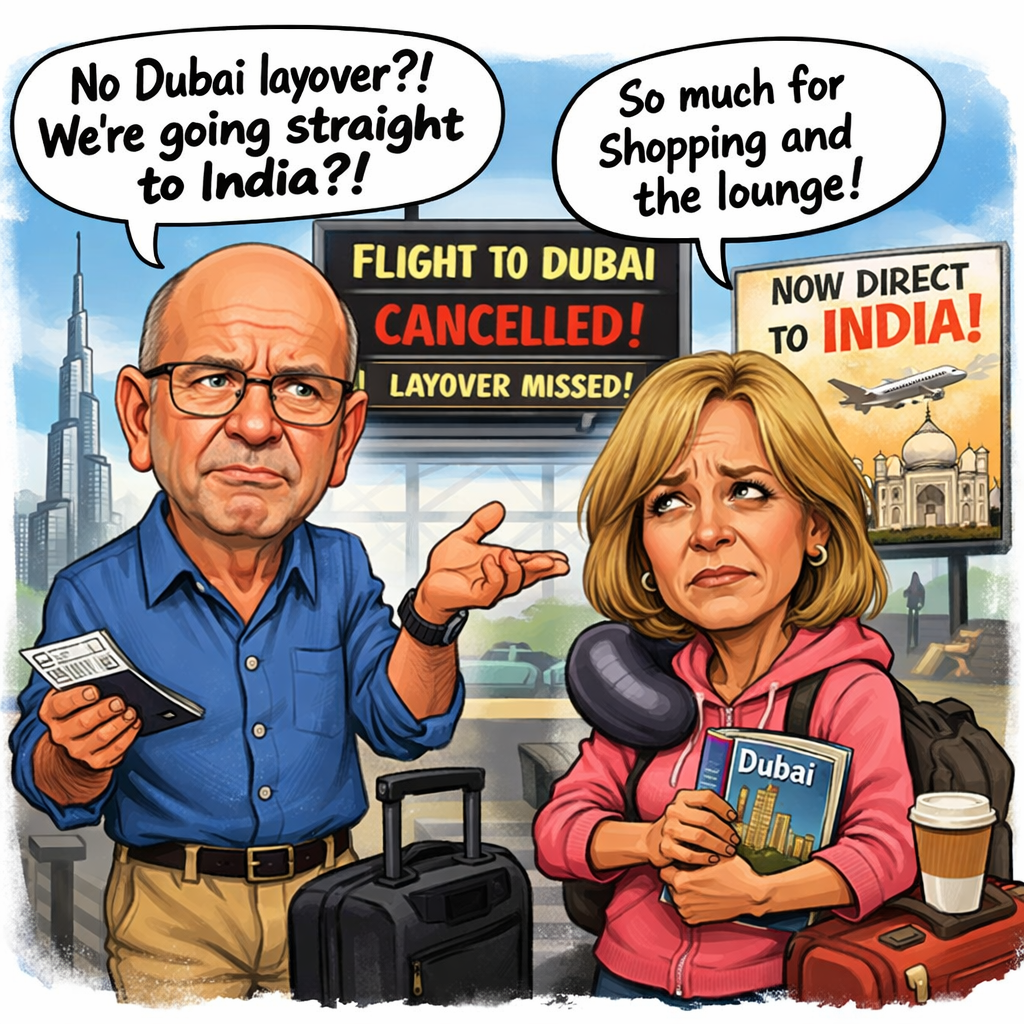
Most travelers hate conflict. A flight gets canceled, the line forms, tempers rise, and people try to keep their heads down. The common hope is simple: the airline will do its best to get you on the next available flight.
But “next available” often turns into something else, especially on international travel.
It turns into: next available on us, when a faster solution may exist via a partner airline, another gateway airport, or a different routing.
That difference can cost you an entire day.
The situation
A long-haul international flight scheduled for late evening is canceled. It’s not just inconvenient — it’s disruptive. You’re thinking about connections, work plans, hotel plans, family plans, and the simple reality that crossing an ocean is not the same as missing a 45-minute shuttle.
In a scenario like this, what most passengers need is not a speech or a shrug. They need two things:
1. A real plan
2. A person who owns it
Instead, what many people get is a long wait, vague updates, and a delayed rebooking that feels like a placeholder.
Then comes the line that changes everything:
“Since this is your home city, you can go home and come back tomorrow morning. We’ll hold your luggage.”
On the surface, that sounds helpful. In practice, it often signals the airline has decided to stop searching beyond its own flights.
Why “go home” can be the wrong answer
Going home isn’t always a gift. Sometimes it’s a way to move the crowd out of the terminal and reduce pressure at the counter.
If your trip matters — and most international trips do — the right question is:
Why aren’t we being offered the earliest way to get there, even if it’s on a partner airline, or even if we have to depart from another airport like JFK?
For many international routes, there are options:
• Partner carriers within the same alliance
• Alternate hubs
• Alternate airports within easy reach
• Same-night departures that still get you there sooner than “tomorrow morning”
When those options exist, passengers should not be quietly parked for 10–12 hours without a serious search.
The real stress: uncertainty
Delays are frustrating. Uncertainty is worse.
If the “tomorrow morning” flight becomes a noon flight, and then you’re told noon might cancel too, you’re no longer dealing with a schedule change. You’re dealing with a rolling problem.
This is where travelers feel trapped:
• The plan keeps moving
• No one gives a clear reason
• No one will say what the backup is
• You start wondering if you’ll be back on the same flight time you had the night before
And that’s when people start asking, quietly but urgently:
Am I getting the whole story? Or am I just being managed?
What should happen in an overnight international cancellation
You don’t need to yell. You need to be specific.
Here’s what a competent response from the airline should look like:
1. A clear explanation of the cause
Weather, ATC, crew legality, mechanical, inbound aircraft — pick one and say it plainly. Cause matters because it drives what the airline will cover.
2. A search for the earliest arrival, not the easiest rebooking
The standard should be: What gets this passenger to their destination soonest?
If a partner airline can get you out sooner — that should be discussed, not hidden behind “it’s your home city.”
4. One owner of the outcome
Passengers don’t need five different answers from five different employees. They need one person with authority who can ticket the solution.
What to say at the counter (without making a scene)
Use calm, simple language that forces a real search:
“I need the earliest arrival to my final destination today or tonight. Please check all routings, including partner airlines and alternate gateways. I’m willing to depart from JFK if that gets me there sooner.”
If they keep circling back to the same delayed flight:
“I’m not accepting another roll without a backup. Please escalate to a supervisor who can protect me on partner options.”
And ask the key question that separates real answers from soft answers:
“Is the cancellation being coded as controllable or weather/ATC?”
That one sentence changes the conversation, because it pushes the airline to be accountable for what it will provide.
What you can reasonably expect
In the U.S., “compensation” usually isn’t a guaranteed check for your time. What matters most in the moment is:
• Getting rebooked effectively
• Hotel/meal support if you’re stuck overnight (especially when it’s within airline control)
• Written documentation of what happened
• Keeping receipts for out-of-pocket expenses tied to the disruption
Goodwill credits and miles may come later. The priority at the airport is getting moved — with confidence — not hope.
The point
This isn’t about being difficult. It’s about avoiding wasted time.
When a flight cancels overnight, the passenger is exposed. The airline has systems, authority, and options. The passenger has one tool: the ability to insist on a real plan.
At Summit Management Services, we spend our lives solving travel problems under pressure. The lesson is consistent:
Be polite. Be direct. Ask for the earliest arrival. Ask for partner options. Ask for the reason code. Get it in writing.
If your trip matters, don’t let “go home” be the end of the conversation.