
By Joe Lipman, President – Summit Management Services
After 50 years in the meetings, travel, and events industry, one thing has never changed:
It is incredibly difficult to move thousands of people, house them, feed them, transport them, keep them safe, and make sure they leave with a smile on their face.
That's why I've found myself watching the 2026 FIFA World Cup through a different lens. While millions are focused on the action on the field, I'm also watching the extraordinary logistics behind the scenes.
The planning, coordination, transportation, security, hotels, restaurants, volunteers, training facilities, communications, and hospitality required to host teams and fans from around the world are nothing short of remarkable. The organizational skills demonstrated by FIFA, the host cities, local organizing committees, convention and visitor bureaus, hotels, transportation providers, and thousands of volunteers deserve tremendous credit.
Does everything go perfectly? Of course not. Anyone who has ever managed a major meeting, convention, sporting event, or incentive program knows there are always unexpected challenges, last-minute changes, weather issues, transportation delays, and logistical surprises. Success isn't measured by the absence of problems—it's measured by how quickly and professionally they're solved.
As someone who has spent a lifetime producing meetings and events, I have a deep appreciation for the thousands of people working behind the scenes who will never appear on television. Their work allows millions of fans to simply enjoy the experience.
But beyond the logistics, this World Cup has reminded me of something even more important.
Sometimes it takes visitors to remind us of who we are.
Watching the 2026 FIFA World Cup has been a lesson—not just in soccer, but in people. Millions have traveled from every corner of the globe to the United States, bringing with them their flags, songs, traditions, and pride. They have filled our streets, restaurants, hotels, parks, and stadiums with excitement, laughter, and friendship.
What Have We Learned?
We've learned that America is a beautiful place. A welcoming place. A place where people from every nation can gather, celebrate, and simply enjoy being together.
We've learned that enormous crowds can have fun without destroying neighborhoods, setting fires, vandalizing property, or leaving taxpayers to clean up the damage. These fans are governed not by heavy-handed policing, but by respect—for one another, for the communities they visit, and for the game itself.
It makes you wonder why we have ever accepted the kind of destruction we've witnessed in some American cities over the past several years. We should expect better. Civility and responsibility are not impossible—they're being demonstrated every day by people who have traveled thousands of miles to be here.
We've also learned something else.
Not everyone needs to stay in the middle of a major city to have an unforgettable experience.
One of the most fascinating aspects of this World Cup is that many teams chose to make their temporary homes in welcoming communities outside the largest metropolitan areas. They paired outstanding hotels with exceptional training facilities, many located at colleges, universities, and professional sports complexes. Rather than disappearing behind the walls of downtown hotels, these athletes became part of the communities that welcomed them.
Perhaps there's a lesson here for professional sports in America.
Sports are supposed to be about the game, the athletes, the teamwork, the passion, and the camaraderie—not about how much fans can be charged for a ticket, parking, a hot dog, popcorn, or a soft drink.
Watching supporters from Cabo Verde, Norway, Spain, Germany, Ecuador, South Africa, and dozens of other nations reminds us why people fall in love with sports in the first place. Some of these countries are small. Some have little chance of winning the tournament. Yet every team steps onto the field believing that history is still possible.
And they're making that history here in the United States of America.
The Best Moments Aren't Inside the Stadium
Perhaps the most heartwarming part of this World Cup hasn't happened inside the stadiums.
It's happened in communities across America.
From Kansas City and Lawrence, Kansas, to Tampa, Florida, Morristown, New Jersey, Renton, Washington, Winston-Salem, North Carolina, and Frisco, Texas, communities have embraced teams from around the world.
Families have invited players and supporters into their homes for backyard barbecues and family dinners. Young soccer players have attended training sessions and community events where professional athletes have volunteered their time, signed jerseys, posed for photographs, and spent hours encouraging the next generation.
One of my favorite examples has been Cabo Verde, whose team has made Tampa, Florida, its home during the tournament. They haven't simply trained there—they've embraced the local community, demonstrating that the World Cup is about far more than ninety minutes on the field.
Can you imagine being ten years old and having a World Cup player show up at your neighborhood soccer field to spend an afternoon teaching you the game?
They're not doing it because they're being paid. They're doing it because they love the sport, because someone once inspired them, and because they understand that giving back is part of being a champion.
Those moments will never appear on a scoreboard, but they may become the greatest legacy of the 2026 World Cup.
A Salute to American Hospitality
Finally, a salute to the families, restaurants, bars, hotels, volunteers, convention and visitor bureaus, destination organizations, and local businesses that welcomed these visitors without taking advantage of them.
To those who kept prices fair, greeted visitors with a smile, answered questions, gave directions, recommended local restaurants, and made guests feel at home rather than treating them as an opportunity to make a quick dollar—my hat is off to you.
You demonstrated what hospitality professionals have always known: people may remember the game, but they'll never forget how you made them feel.
One Final Thought
If you don't believe how much fun people are having, spend a few minutes on Instagram, Facebook, YouTube, or watch the evening news. You'll see neighborhoods, restaurants, parks, hotels, and stadiums across our great nation filled with people from every corner of the world laughing, celebrating, singing, and proudly cheering for their countries.
As these teams pursue a place in soccer history, they've also reminded us of something just as important: at its best, sport has the power to bring out the very best in people.
I've enjoyed every minute of it.
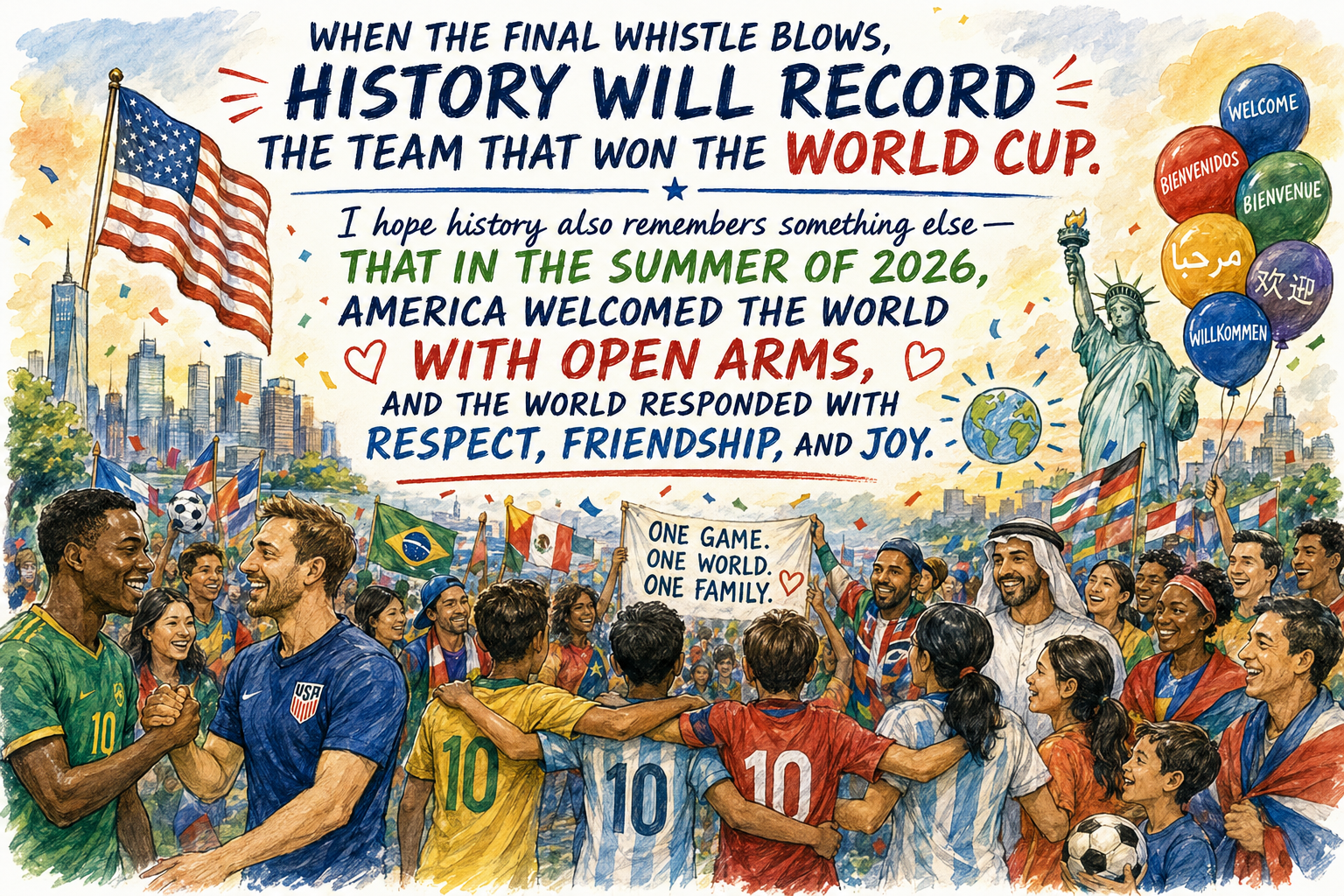
When the final whistle blows, one nation will lift the World Cup trophy. But America will have earned something just as meaningful—the admiration of millions of visitors who experienced our hospitality, our communities, our generosity, and our ability to welcome the world.
For me, that's a victory worth celebrating.
#HistoryWillBeWrittenInRealTime #HistoryIsREWrittenInRealTime #WorldCup2026 #FIFAWorldCup #Hospitality #Travel #EventProfs #MeetingPlanners #SportsTourism #Leadership
Joe Lipman
President
Summit Management Services
#HistoryIsWrittenInRealTime #HistoryIsREWrittenInRealTime #WorldCup2026 #FIFAWorldCup #Hospitality #Travel #EventProfs #MeetingPlanners #SportsTourism #Leadership