During a recent discussion in Frankfurt with the team from WeSpeak, we explored a growing trend that is quickly moving into mainstream international meetings: AI-driven multilingual communication platforms.
For years, international conferences followed a familiar formula when language interpretation was required.
Interpreter booths.
Headsets.
RF receivers.
Dedicated language channels.
Large technical setups.
And significant expense.
It worked - but it also created limitations.
Smaller meetings often could not justify the cost.
Roundtable discussions became difficult.
Informal networking conversations were frequently lost across language barriers.
And audience participation was often limited to those comfortable speaking the dominant meeting language.
That model is now beginning to change.
The concept is surprisingly simple.
A speaker presents in English. Or any language.
Attendees scan a QR code.
They select their preferred language.
And the system delivers near real-time translated audio and text directly to their phone or device.
But the real breakthrough is not the translation itself.
It is participation.
These newer systems are no longer simply one-way interpretation tools. They are becoming live multilingual communication environments.
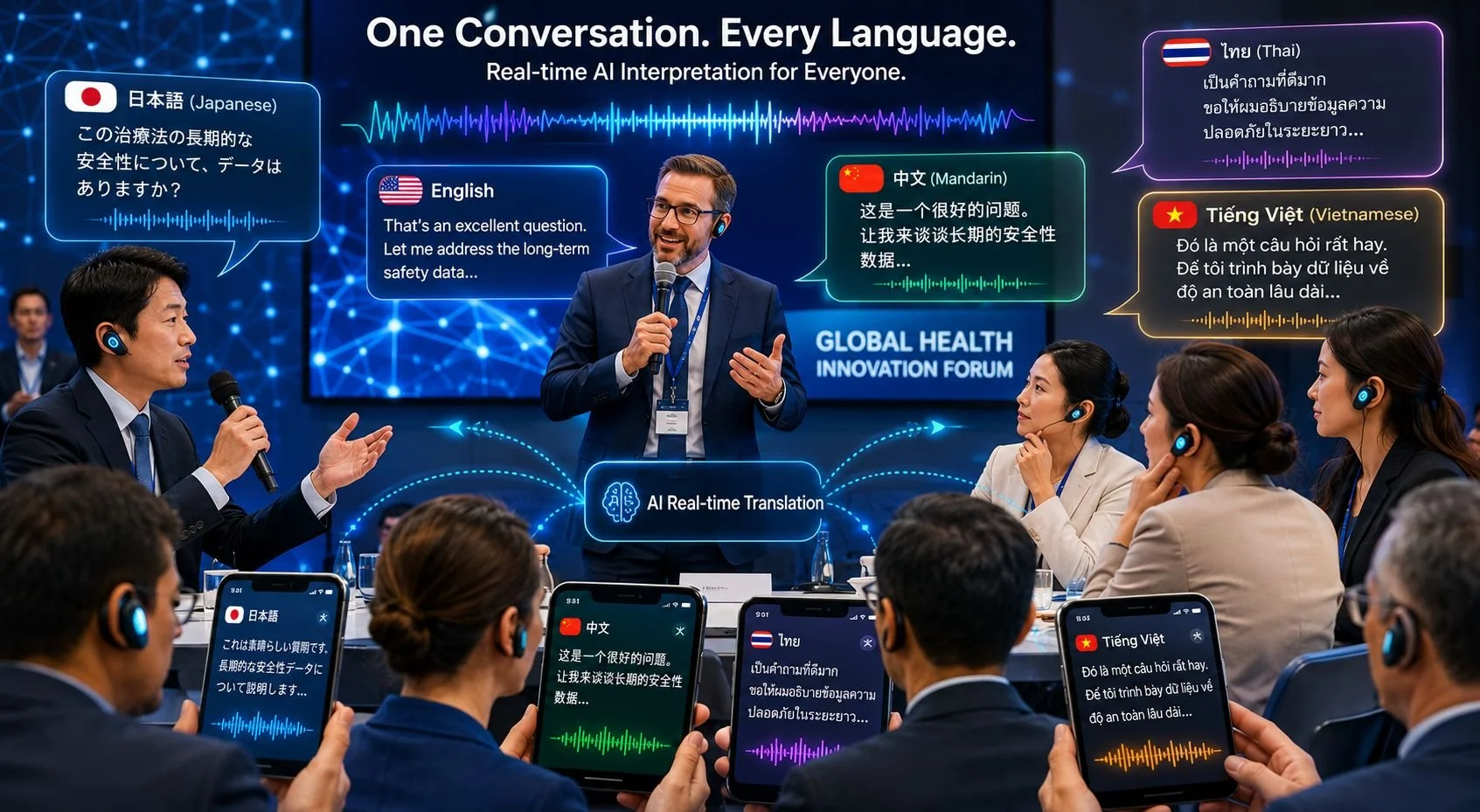
A physician attending from Japan can ask a question in Japanese.
The moderator hears the question in English.
At the same time, other attendees can hear or read the same question translated into Mandarin, Thai, Vietnamese, or additional languages selected by the audience.
The conversation becomes interactive instead of segmented.
That distinction matters enormously in medical, pharmaceutical, scientific, and advisory board meetings where discussion and collaboration are often more valuable than the presentation itself.
For the meetings industry, this represents a major operational shift.
Historically, multilingual meetings required:
interpreter travel
booth construction
headset distribution
onsite channel management
multiple interpreters per language
freight and logistics coordination
Now much of that infrastructure can potentially be replaced with:
software platforms
cloud-based AI translation
attendee smartphones
minimal onsite hardware
a stable internet connection
For smaller high-touch meetings, investigator meetings, KOL discussions, and executive roundtables, the implications are significant.
Meetings become more globally accessible.
Audience participation increases.
International attendees engage more comfortably.
Hybrid meeting support improves dramatically.
And operational complexity can potentially decrease.
Of course, an important question immediately follows:
Why not simply use generic AI translation apps?
The answer is that professional conference communication involves far more than basic translation.
What these specialized systems are actually managing includes:
audio routing
speaker recognition
participant management
multilingual moderation
terminology handling
question flow
low-latency delivery
privacy and compliance concerns
integration with AV systems
In regulated industries such as pharmaceutical and medical meetings, those details matter tremendously.
A scientific discussion involving clinical outcomes, patient data, regulatory terminology, or highly technical medical language cannot rely solely on consumer-grade translation tools.
That is why many organizations are now adopting a hybrid approach.
AI handles much of the general communication.
Human interpreters remain available for critical sessions, nuanced scientific discussions, legal matters, and highly sensitive conversations.
The result is not necessarily the elimination of simultaneous interpretation.
It is the evolution of it.
The future conference environment may ultimately look very different from the traditional model many of us have worked within for decades.
Headset distribution may largely disappear.
Interpreter booths may become smaller or more specialized.
Breakout sessions may become far more multilingual.
Networking conversations may become dramatically more inclusive.
And perhaps most importantly, more attendees may finally feel comfortable joining the discussion rather than simply listening from the sidelines.
That may be the most important translation of all.
Joe Lipman,
President Summit Management Services
I’m not offering legal advice. I’m sharing industry experience. It’s practical insight from experience—not legal representation.