20 Ways to Make Travel Actually Work the Way It Should
I came across a list of “10 things to upgrade your flight experience.”
Some of it was fine.
But like most of these lists, it missed the point.
After a lifetime in the travel business, here’s the reality:
Travel doesn’t break because you forgot a neck pillow.
Travel breaks because of decisions made days—or weeks—before you ever get to the airport.
It’s not about hacks.
It’s about preparation and judgment.
Here’s what actually makes a difference.
The Basics (Most People Get Right)
These are simple—but they matter because they remove friction.
Download your boarding passes, shows, and music ahead of time.
Don’t rely on airport Wi-Fi or a last-minute connection.
Bring an empty water bottle.
Hydration matters more than people think, especially on longer flights.
Pack a small comfort kit.
Whatever that means for you—medication, wipes, toothbrush—keep it accessible.
Wear layers.
Cabin temperatures change. You don’t control that.
Choose your seat strategically.
Window for sleep. Aisle for mobility. Middle—avoid when you can.
Bring snacks.
Airlines don’t control your schedule—you should.
Use a neck pillow and eye mask.
Not glamorous, but effective.
Set your watch to destination time.
Start adjusting before you land.
Use noise-canceling headphones.
They don’t just improve comfort—they reduce fatigue.
Board calm.
The rush doesn’t change your seat assignment.
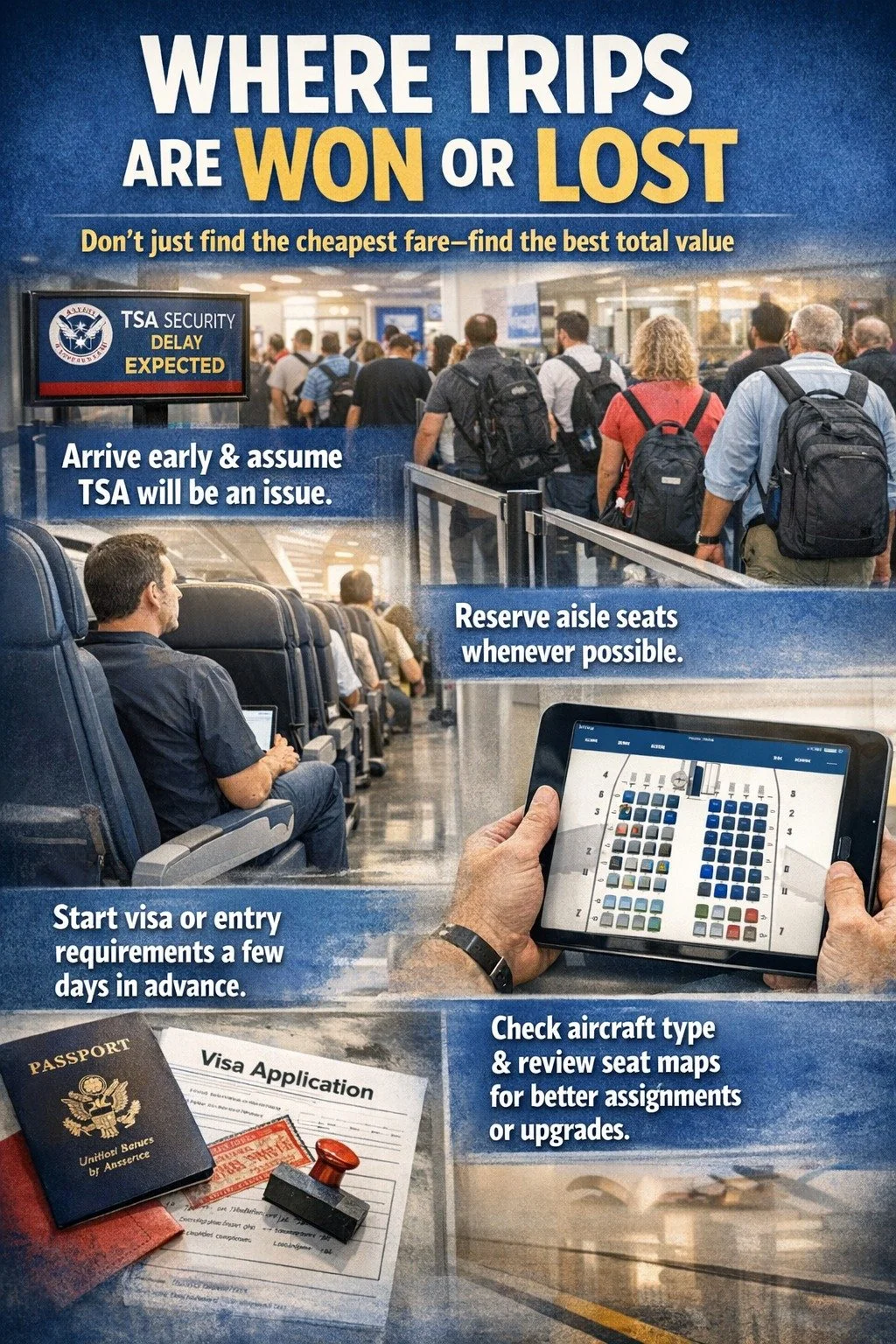
Where Trips Are Won or Lost
This is where experience shows.
Don’t just find the cheapest fare—find the best total value.
A $200 savings isn’t worth a bad connection, poor routing, or no recovery options.
Arrive early—and assume TSA will be an issue.
If everything runs smoothly, you wait.
If it doesn’t, you’re protected.
Reserve aisle seats whenever possible.
You control your movement, not the person next to you.
Start visa and entry requirements a few days in advance.
Not at the airport. Not the night before.
Countries change requirements—don’t assume anything.
Check the aircraft type before booking.
Then check the seat map.
Some planes—and some configurations—are significantly better than others.
Bring a fully charged portable battery.
A dead phone today is more than an inconvenience—it’s your boarding pass, your ID backup, your connection to everything.
Screenshot everything.
Boarding passes. Hotel confirmations. Transfers. QR codes.
Keep a copy with your passport.
Do not rely on apps.
Signals fail. Airports go offline. Customs halls often have no connectivity.
Pack a change of clothes in your carry-on.
If you land at 10:00 AM and your room isn’t ready until 4:00 PM, you’ll want options.
Pre-select meals when available.
It’s a small step that avoids unnecessary problems.
Avoid tight connections.
This is one of the biggest mistakes travelers make.
A 45-minute connection might work on paper.
It rarely works when anything goes wrong.
What Most Travelers Miss Completely
Here’s what rarely gets said:
Airlines don’t prioritize your schedule.
Hotels don’t prioritize your arrival time.
Systems don’t adapt to you—you have to plan around them.
Recovery is everything.
If your first flight is delayed, what are your options?
If you miss a connection, is there another flight?
If your luggage doesn’t arrive, are you prepared?
Most travelers don’t think about this.
Professionals do.
Booking Strategy Matters More Than Anything
This is where trips are either protected—or exposed.
Flight timing matters.
Early flights tend to run more reliably than late ones.
Routing matters.
Nonstop is always better than connecting—until it isn’t.
Sometimes a better connection gives you more recovery options.
Airline choice matters.
Not all carriers handle disruptions the same way.
Ticket type matters.
Basic economy may save money—but it removes flexibility when you need it most.
Seat availability matters.
A full flight gives you fewer options when things change.
Upgrade paths matter.
Knowing where opportunities exist can change the entire experience.
The Reality
The biggest difference in travel isn’t what you pack.
It’s what—and how—you book.
Everything else is secondary.
You can have the perfect carry-on, the best headphones, and every “tip” in the world.
But if your flight is poorly timed, your connection is too tight, and you have no backup options—none of it matters.
Final Thought
Good travel feels easy. But it’s not accidental. It’s planned that way.
— Joe Lipman joe@summitmgt.com
#JoeKnows #TravelSmart #BusinessTravel #FrequentTraveler #TravelTips #AirTravel #TravelPlanning #MeetingsAndEvents #IncentiveTravel #SummitManagementServices #TravelIndustry #ClientExperience #PlanAhead #TravelBetter #Aviation #RoadWarrior #SmartTravel #TravelStrategy #EventProfs #TravelInsights #HistoryIsWrittenInRealTime