Cruise Gratuities: Are You Tipping or Paying Payroll?
Gratuities on a cruise used to be one of the simplest parts of the experience.
You tipped the people who took care of you. You saw them every day. You knew exactly where your money went.
That clarity is gone.
Today, most cruise lines automatically charge between $16 and $25 per person, per day. It’s labeled as a gratuity—but in practice, it operates very differently.
The better question is:
Is it really a tip anymore?
What Automatic Gratuities Actually Are
Automatic gratuities are not handed directly to your cabin attendant or your waiter.
They are collected into a centralized pool and distributed across multiple departments.
That includes:
Front-facing crew:
Cabin attendants
Dining room wait staff
Buffet service teams
Behind-the-scenes crew:
Galley (kitchen staff)
Laundry operations
Cleaning and sanitation teams
This broader distribution matters. A cruise ship runs on far more than the people you see.
But here’s where the system becomes unclear.
There is no published breakdown.
You won’t find a chart showing:
Who gets what percentage
How much goes to each role
How the funds are calculated or adjusted
Instead, cruise lines allocate internally based on rank, department, and contract structure.
The Missing Transparency
If a charge is automatic, most guests assume:
It’s fixed
It’s traceable
It’s directly tied to service
None of that is fully visible.
Which leads to a reasonable conclusion:
Automatic gratuities function more like a built-in service charge than a discretionary tip.
From a business standpoint, that makes sense.
It creates:
Predictable income for crew
Lower base wages supported by pooled funds
A consistent revenue stream managed by the cruise line
In other words, part of what used to be optional has become embedded in the pricing model.
What About Bar Staff?
Bar service is handled separately.
Most cruise lines add:
18%–20% service charge on every drink
That goes into a different pool specific to bar and beverage teams.
So when you order a cocktail, you are already tipping—whether you realize it or not.
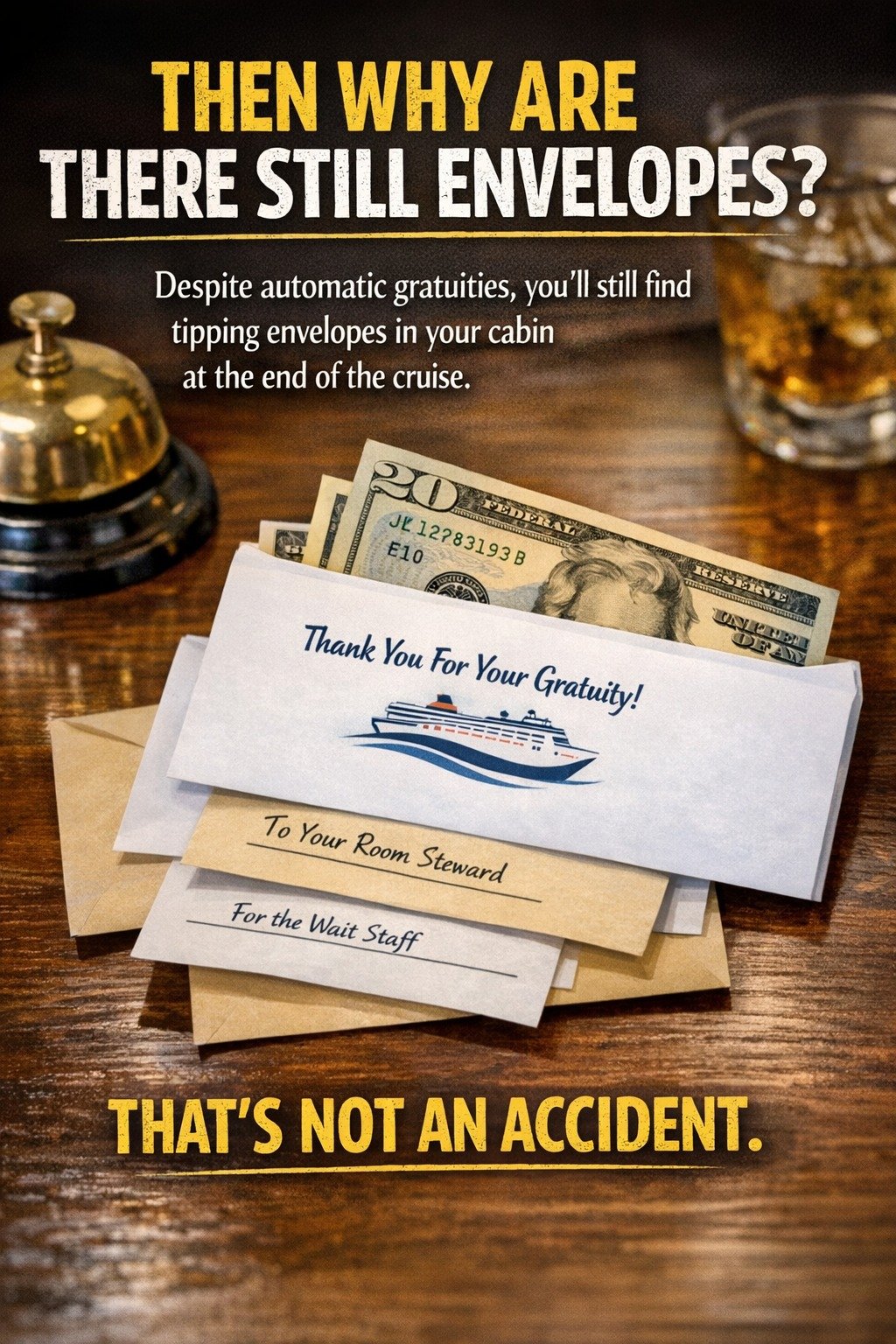
Then Why Are There Still Envelopes?
Despite automatic gratuities, you’ll still find tipping envelopes in your cabin at the end of the cruise.
That’s not an accident.
Those envelopes exist for one reason:
Direct tipping still matters.
When you hand cash directly to a crew member:
It does not go into the pool
It is not redistributed
It is a personal acknowledgment of service
And for many crew members, that extra income is meaningful.
What Experienced Travelers Actually Do
Most seasoned travelers don’t fight the system—they work within it.
They follow a simple, two-part approach:
Tip Personally (Where It Matters)
This is where you take control.
At the end of the cruise even if included:
Cabin Attendant $20–$100+ depending on service and length of cruise This is the one person you should almost always tip extra
Dining Staff (if consistent team) $20–$50 per main waiter / assistant Only if you had regular interaction and good service
Bartenders (if you had a “go-to”) $10–$30 at the end, even with service charges already added
When You Might Adjust the Plan
Exceptional service: Tip more—this is where it matters most
Poor service: Don’t remove auto gratuities, but you can skip extra tipping
Guest Services pressure to remove gratuities: Rare, but don’t feel obligated
What NOT to Do
Don’t remove automatic gratuities unless something was seriously wrong
Don’t assume the system fully rewards individuals (it doesn’t)
Don’t rely on envelopes alone—be intentional about who you recognize
Final Thought
Cruise gratuities today sit in a gray area.
They are:
Not fully optional
Not fully transparent
Not directly tied to individual service
Yet they remain essential to crew compensation.
Until there is more clarity, the best approach is simple:
Understand the system—and tip with intention.
Because at the end of the day, the people delivering the experience still matter most.