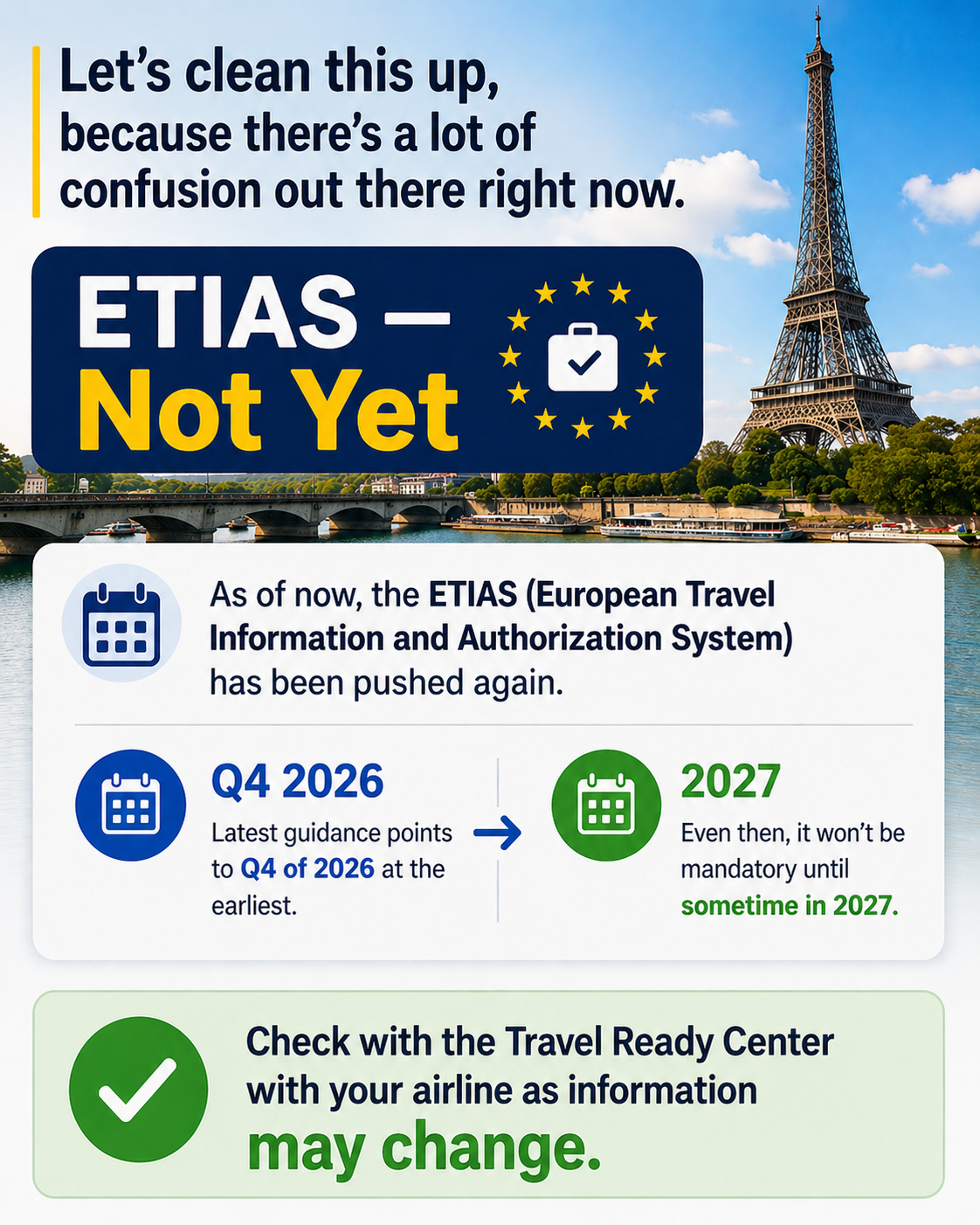
Let’s clean this up, because there’s a lot of confusion out there right now.
Everyone keeps talking about ETIAS like it’s happening tomorrow. It’s not.
ETIAS — Not Yet
As of now, the ETIAS (European Travel Information and Authorization System) has been pushed again. Latest guidance points to Q4 of 2026 at the earliest, and even then, it won’t be mandatory until sometime in 2027.
That means if you’re traveling to Europe this year or even much of next year, you do NOT need ETIAS.
What Is Happening — Right Now
What has gone live is the Entry/Exit System (EES).
This is the real change, and it matters.
After a phased rollout that began in October, the system is now active across 29 European countries.
What EES Actually Does
Eliminates passport stamping
Digitally records every entry and exit
Tracks overstays automatically
Logs refused entries
Captures biometric data (facial image + fingerprints)
In simple terms: Europe now knows exactly when you arrive, when you leave, and how long you stayed.
The Rule That Matters
90 days within a 180-day period for short-stay travelers
That rule isn’t new — but enforcement just got real.
What This Means for You
If you’re a U.S. traveler heading to Europe:
You can still travel as you always have (no ETIAS yet)
But your time in Europe is now digitally tracked — no gray area
Overstays will be flagged automatically
The Reality
We’ve moved from a stamp-in-the-passport system to a fully digital border environment.
No more guesswork. No more “they didn’t notice.”
Call it modernization. Call it control.
Either way — it’s here. #RobKnows #AskMrLipman
Please Note: We are not offering legal advice. I’m sharing industry experience. It’s practical insight from experience—not legal representation.