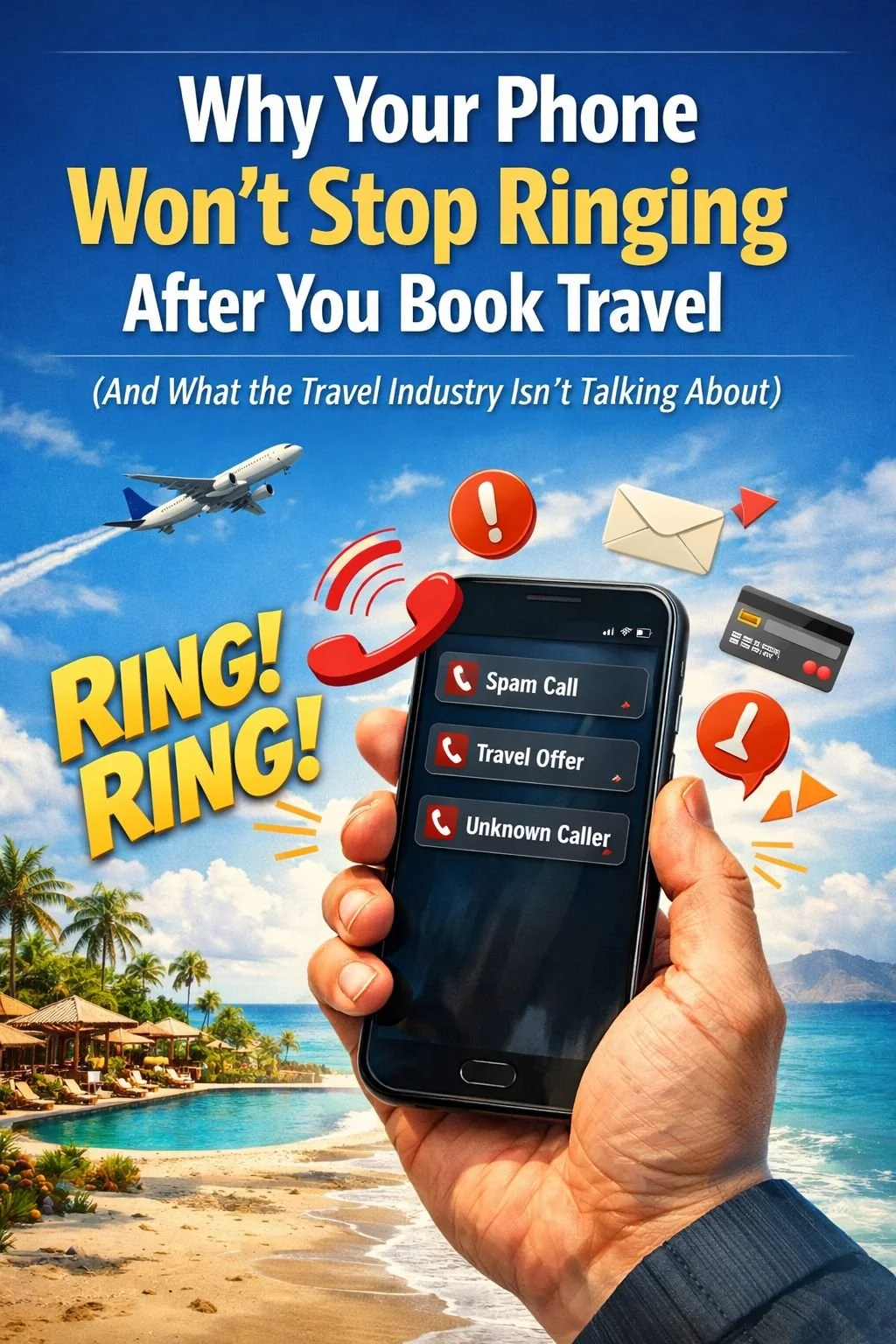
You book a trip.
Maybe it’s a cruise.
Maybe it’s a resort.
Maybe it’s a quick flight and hotel.
And then it starts.
Calls. Emails. Texts.
Travel offers. Insurance pitches. “Upgrades.” Credit card offers. Timeshares.
At first, it feels like coincidence.
It’s not.
Your Trip Didn’t Stay Between You and Your Travel Advisor
People assume when they book travel, their information stays within:
• The airline
• The hotel
• The cruise line
• The travel advisor
That used to be closer to reality.
Today, your data moves.
And it moves fast.
When you enter your information, even in legitimate places, it can pass through:
• Booking platforms
• Marketing systems
• Affiliate networks
• Data partners
Each step creates another opportunity for your information to be shared, matched, or sold.
The “Lead” Economy Inside Travel
Here’s something most travelers don’t realize:
Your trip can turn into a lead.
And leads have value.
If you:
• Search for a cruise
• Compare all-inclusive resorts
• Request pricing
• Look at travel insurance
That activity can signal:
“This person is about to spend money.”
So your information can end up in ecosystems where:
• Insurance companies reach out
• Credit card companies target you
• Other travel companies try to intercept or upsell
You didn’t ask for it.
But your behavior triggered it.
Even Legitimate Travel Channels Contribute
This isn’t just about shady operators.
Even reputable companies use:
• Third-party marketing platforms
• Retargeting systems
• Data enrichment services
Which means your information can be:
• Matched with other databases
• Appended with additional details
• Used in campaigns you never directly signed up for
Often legally.
A Simple Trick I Use (That Tells Me Exactly Who Sold My Info)
Here’s something I do personally, and it’s surprisingly effective.
When I fill out forms online, I’ll sometimes enter my name in all lowercase.
Instead of:
Joe Lipman
I’ll use:
joe lipman
Now, when emails or calls start coming in addressed that way, I know exactly what happened:
That source shared or sold my information.
It gives me a clear signal:
• Where the leak likely came from
• Which companies are passing data downstream
And from there, I block, filter, and shut it down.
It’s a small move, but it gives you visibility in a system that’s otherwise invisible.
Why This Hits Frequent Travelers Harder
If you travel often, like many of my clients:
You are more exposed.
Because your profile becomes more valuable:
• Higher spend
• Predictable behavior
• Repeat booking patterns
You’re not just a traveler.
You’re a high-value data profile.
What I See From the Inside
Being in this business my entire life, I can tell you:
There’s a big difference between:
• High-touch, controlled travel planning
and
• Open, digital booking ecosystems
When everything runs through:
• Quote engines
• Comparison sites
• Broad marketing funnels
Your data footprint expands quickly.
When it’s handled in a more controlled, relationship-driven way:
Exposure drops.
Why the Outreach Feels So Targeted
Ever notice how the calls and emails feel relevant?
That’s because your data gets:
• Scored
• Categorized
• Sold with context
So instead of random spam, you get:
• “Cruise upgrade offers”
• “Luxury travel credit cards”
• “Travel insurance follow-ups”
It feels personalized because it is.
What Travelers Can Do
You don’t need to disappear, but you should be intentional.
A few practical moves:
• Use a dedicated email for travel bookings
• Be cautious on “compare and save” sites
• Limit how many places you request quotes from
• Work with trusted, controlled channels
• Monitor where your data shows up
• Use small tracking tactics (like name variations) to identify leaks
What the Travel Industry Needs to Do (And Hasn’t Yet)
Here’s the part that doesn’t get talked about enough:
This isn’t just a consumer problem.
It’s an industry responsibility.
Right now, the travel industry benefits from data flow, but doesn’t control it.
That needs to change.
1. Push for a Real Privacy Standard
Europe has already set a framework with GDPR.
It’s not perfect, but it establishes something critical:
Clear ownership of personal data.
The U.S. doesn’t have that.
The travel industry should be pushing for:
• A unified federal privacy standard
• Clear limits on data resale
• Real accountability for third-party sharing
2. Demand Transparency in the Booking Chain
Travel companies should be required to clearly disclose:
• Who receives your data
• Who they share it with
• How long it’s retained
Not buried in a 40-page agreement.
Simple. Visible. Understandable.
3. Stop Treating Travelers Like Leads
There’s a difference between:
• Serving a client
and
• Selling a profile
The industry needs to draw that line again.
If someone books a trip, that should not automatically:
• Trigger downstream marketing pipelines
• Open the door to unrelated outreach
4. Create a “Do Not Share” Standard
We have “Do Not Call.”
What we don’t have is:
“Do Not Sell or Distribute My Travel Data.”
That should exist.
And it should be easy to activate.
5. Protect the Advisor-Client Relationship
This is where professionals have an advantage.
A trusted advisor relationship should:
• Limit data exposure
• Control where information flows
• Act as a buffer between client and the open market
That’s not just service.
That’s protection.
Final Thought
Travel is one of the best parts of life.
But behind the scenes, it has quietly become one of the largest pipelines of personal data distribution.
Not because the industry set out to do that.
But because no one stepped in to stop it.
That’s the next evolution of this business.
Not just better trips.
Better protection for the people taking them.
Take a look. You may start seeing your own travel bookings very differently.
#JoeKnows #TravelPrivacy #DataBrokers #TravelIndustry #ConsumerAwareness
#DigitalFootprint #HistoryIsWrittenInRealTime