
Why Are Cruise Lines Still Making Internet So Complicated?
You book your cruise. You select your cabin. You pay your fare. Perhaps you've even purchased a cruise package that includes internet access.
Then, as your departure approaches, the emails begin.
Upgrade your internet! Add more devices! Browse! Browse & Stream! Save 30%!
Sounds like a bargain, doesn't it?
But wait a minute.
What exactly am I buying, and why has something as simple as connecting to the internet become so complicated?
Recently, while reviewing internet options for an upcoming MSC cruise, I came across these offers:
Internet Package
Advertised Price
Browse & Stream – 2 Devices
$183 per adult
Browse – 3 Devices
$188 per adult
Browse – 4 Devices
$228 per adult
And here's the interesting part.
My cruise already includes internet access for one device per person!
So what am I paying extra for?
Am I buying additional connections? Faster service? Streaming capability? Or am I paying again for something that's already included?
Welcome to the increasingly confusing world of cruise ship internet.
One Person, Three Devices. Why Do I Need Three Internet Connections?
Think about how you use the internet at home or in your office.
You have a cellphone, perhaps an iPad or tablet, and maybe a laptop.
In the morning, you check your emails on your phone. After breakfast, you read the news on your tablet. Later, you open your laptop to take care of business.
Three devices.
But are you using all three simultaneously?
Probably not.
So here's my first question.
If I've paid for one internet connection, why can't I use it on whichever device I happen to need at that moment?
Can I disconnect my cellphone, connect my laptop, finish working, and return to my phone?
Or does the cruise line permanently lock my connection to the first device I register?
Believe it or not, MSC's published internet rules state that once a device is activated, it cannot be switched for another during the cruise.
And this isn't just a policy published on its U.S. website. The same restriction appears on its United Kingdom and international websites.
Think about that.
I can have three perfectly good devices sitting on my desk, but my internet package may be tied to just one of them for the entire sailing.
Is that really a technological necessity, or is it a commercial policy that deserves another look?
My Wife and I Already Have Internet. So What Exactly Are We Upgrading?
Now let's make this even more interesting.
My wife and I are sharing a cabin, and each of us already has one internet connection included in our cruise fare.
Now MSC offers me Browse & Stream for two devices at $183 per adult.
Sounds simple enough.
Except it isn't.
Does purchasing Browse & Stream for two devices upgrade both of our existing connections, or am I purchasing two additional connections?
And here's where the questions really begin.
If I purchase a larger internet package, do all the devices covered by that package receive the same level of service?
If I purchase Browse & Stream for two devices, will both devices have streaming capability?
Will both receive the same speed and bandwidth priority, or could performance differ?
Can my wife use one of those streaming connections while I use the other?
If we already have two complimentary Browse connections, do those connections automatically become Browse & Stream?
Or do they remain basic Browse while we're purchasing two entirely separate connections?
And what happens to the internet service that was already included in our cruise fare?
Am I upgrading something I already own, replacing it, or buying the same service all over again?
Now imagine I purchase a three-device or four-device package.
Does every device receive identical connectivity features?
Can some devices Browse while others Stream?
Can the connections be shared between passengers in the same cabin?
And why isn't all of this explained in a simple chart before I click the purchase button?
These aren't complicated technical questions.
They're basic consumer questions about what we're buying.
Here's the Really Interesting Part: Does the Cruise Line Even Understand Its Own Packages?
I've encountered situations where cruise line representatives themselves seem uncertain about how these internet packages work.
And that's where confusion becomes a genuine consumer concern.
Imagine calling the cruise line and asking whether you can switch from your cellphone to your laptop.
The representative tells you yes.
You purchase the package based on that explanation.
Then you board the ship, register your cellphone, and discover you cannot switch devices.
Now what?
Will the cruise line refund your money?
Will it honor what its representative told you?
Will you receive a credit?
Or will you be told that the written terms and conditions take precedence over what you were told on the telephone?
And what if you purchase a premium streaming package because a representative assures you that you can conduct business video conferences, only to discover that the connection isn't reliable enough?
Who's responsible?
I'm not suggesting that every cruise representative provides incorrect information.
But when packages are complicated enough that passengers and representatives can interpret them differently, something needs to change.
If the company selling the product cannot explain it clearly, how can the consumer be expected to understand it?
My advice? Before purchasing, ask for the explanation in writing.
And cruise lines should make their refund and credit policies just as clear as their pricing.
Browse Versus Browse & Stream: What Are We Really Buying?
Most cruise lines divide their internet offerings into different service levels.
Browse generally covers everyday activities such as email, websites, messaging applications, and social media.
Browse & Stream adds support for activities such as video streaming and video conferencing.
But what does that actually mean?
Can I make a WhatsApp voice call?
Can I join a Microsoft Teams meeting?
Can I participate in a Zoom conference?
Can I stream Netflix or YouTube?
And if I pay for streaming, am I guaranteed enough bandwidth to conduct a business meeting without interruptions?
Not necessarily.
Cruise ship internet is subject to available bandwidth, network congestion, satellite coverage, equipment, and other operating conditions.
And even if every device in a premium package has the same service entitlement, that doesn't guarantee identical speeds or performance at every moment.
But here's my point.
If I'm paying for premium connectivity, shouldn't the cruise line explain exactly what that means and what limitations I should expect?
Along Comes Starlink — And Suddenly I See a Different Future
For years, cruise lines could reasonably explain high internet prices by pointing to the extraordinary expense of providing connectivity in the middle of the ocean.
Satellite systems, antennas, equipment, maintenance, bandwidth, and thousands of passengers all involve substantial costs.
I understand that.
But along comes Starlink, and suddenly I see a different future.
Look at United Airlines.
United has made a major commitment to bringing Starlink connectivity across its fleet, with completion targeted for the end of 2027.
On equipped aircraft, United offers complimentary Starlink Wi-Fi to MileagePlus members, with support for multiple connected devices.
Think about that.
At 35,000 feet, an airline is moving toward complimentary, multi-device internet. Yet on a cruise ship, I'm still being asked whether I want to purchase two, three, or four registered devices.
Now, airplanes and cruise ships have different operating environments.
A cruise ship can carry several thousand passengers, all potentially accessing the internet simultaneously.
And the economics of providing service to an aircraft are not necessarily identical to those of a cruise ship.
But the point remains.
Technology is improving. Satellite capacity is expanding. Customer expectations are changing.
Shouldn't the cruise industry's business model evolve along with the technology?
Does Internet Connectivity Differ Around the World?
Here's another question that deserves more attention.
Does the internet service I'm purchasing in the Caribbean perform the same way in the Mediterranean, the Pacific, or the middle of the Atlantic Ocean?
Not necessarily.
Starlink and other modern satellite systems have dramatically improved ocean connectivity, but geography, satellite coverage, network capacity, regulations, and local operating conditions still matter.
The Caribbean
The Caribbean is one of the world's busiest cruising regions, with substantial satellite connectivity.
But busy ports, network congestion, weather, and the number of passengers sharing a ship's connection can influence performance.
The Mediterranean
The Mediterranean generally offers favorable connectivity opportunities, although busy ports, coastal obstructions, and country-specific regulations can affect service.
The Pacific Ocean
The Pacific presents a different environment.
Cruises between Hawaii, Australia, New Zealand, and remote South Pacific islands may travel through long stretches of ocean far from major population centers.
Coverage and performance may differ significantly by location and service plan.
The Atlantic Ocean
Transatlantic crossings involve extended periods far from land.
Satellite coverage, network capacity, redundancy, and onboard equipment become especially important.
Alaska and Northern Europe
Higher latitudes, mountainous coastlines, satellite visibility, and regional operating conditions can influence connectivity.
This doesn't mean Starlink won't work in these areas.
It means passengers shouldn't automatically assume that identical internet packages will deliver identical performance everywhere.
And that raises another question.
If I'm purchasing a premium internet package for a particular itinerary, shouldn't the cruise line tell me what level of service I can reasonably expect along that route?
Especially if I need reliable connectivity for business.
Starlink Is Already on Cruise Ships. So What's Holding Us Back?
This isn't some futuristic idea.
Major cruise operators, including MSC, Royal Caribbean, Carnival, Norwegian, and Virgin Voyages, have adopted Starlink connectivity across portions of their operations.
The technology is already at sea.
But here's an important distinction.
Having Starlink aboard doesn't automatically mean passengers receive unlimited bandwidth, complimentary access, or unrestricted device switching.
Those decisions involve the cruise line's pricing, network management, and commercial policies.
Starlink supplies the connectivity technology.
The cruise line determines how that connectivity is packaged and sold to its passengers.
And that's where I believe the opportunity lies.
Is Internet a Revenue Generator or a Competitive Advantage?
Cruise lines have every right to recover their operating expenses and earn a profit.
But let's acknowledge something.
Internet packages are also an opportunity to generate additional onboard revenue.
And when passengers are presented with multiple packages, per-person charges, streaming upgrades, and device allowances, it becomes difficult to determine whether they're buying something they genuinely need.
Consider the marketing opportunity of a cruise line advertising:
"Complimentary Starlink Wi-Fi. Connect your phone, tablet, or laptop. No complicated device packages."
Would that influence your choice of cruise line?
It might influence mine.
Cruise lines invest enormous sums in entertainment, dining, technology, loyalty programs, and creating memorable guest experiences.
Why frustrate those same guests over internet access?
Why not turn connectivity into a competitive advantage rather than another complicated onboard purchase?
And perhaps the real opportunity isn't simply to eliminate internet charges.
Perhaps it's to create a better customer experience that encourages loyalty, repeat business, and positive word of mouth.
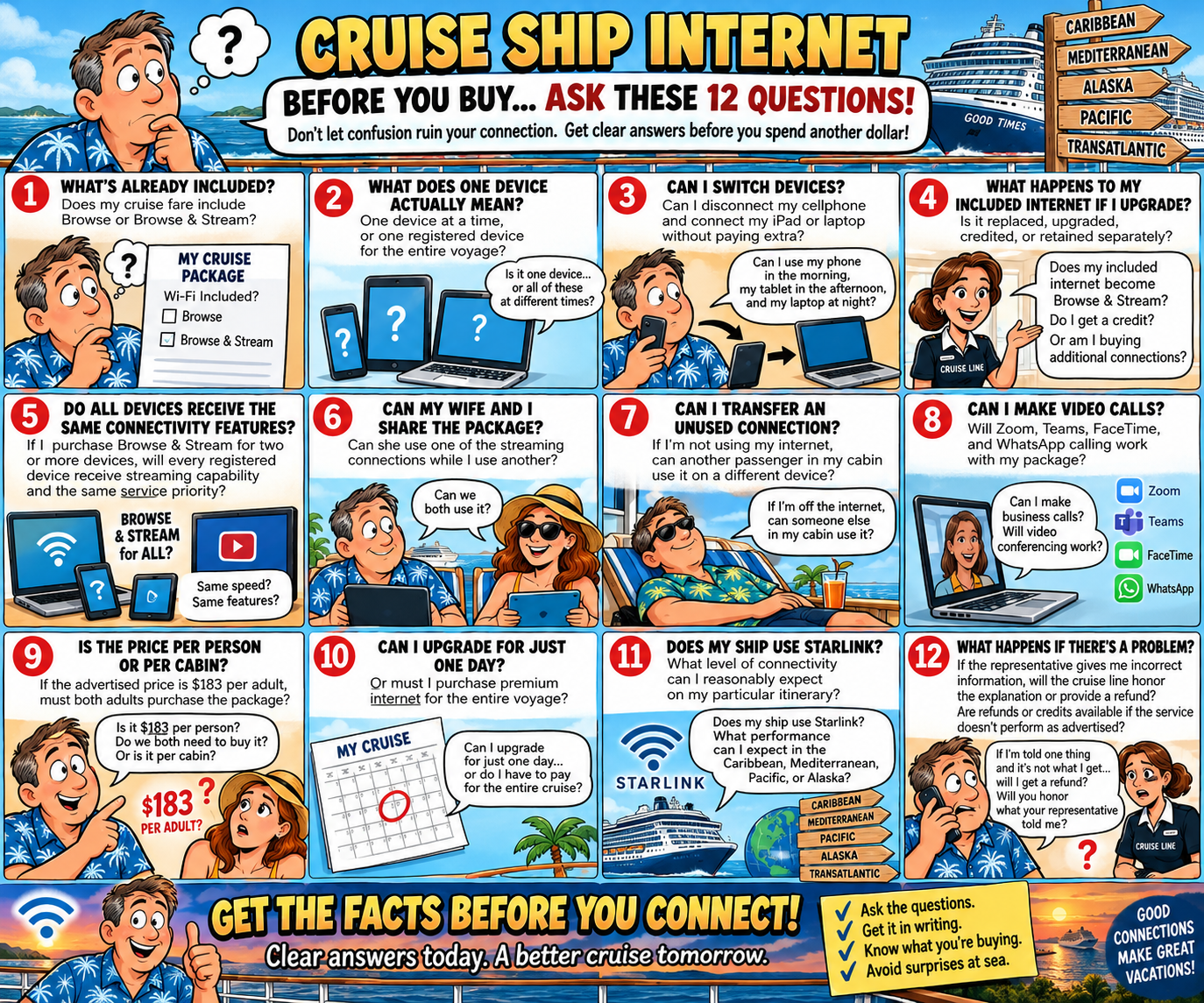
The Questions Every Passenger Should Ask Before Buying Internet
Before spending another dollar, I would want clear answers to the following:
What's already included? Does my cruise fare include Browse or Browse & Stream?
What does one device actually mean? One device at a time, or one registered device for the entire voyage?
Can I switch devices? Can I disconnect my cellphone and connect my iPad or laptop without paying extra?
What happens to my included internet if I upgrade? Is it replaced, upgraded, credited, or retained separately?
Do all devices receive the same connectivity features? If I purchase Browse & Stream for two or more devices, will every registered device receive streaming capability and the same service priority?
Can my wife and I share the package? Can she use one of the streaming connections while I use another?
Can I transfer an unused connection? If I'm not using my internet, can another passenger in my cabin use it on a different device?
Can I make video calls? Will Zoom, Teams, FaceTime, and WhatsApp calling work with my package?
Is the price per person or per cabin? If the advertised price is $183 per adult, must both adults purchase the package?
Can I upgrade for just one day? Or must I purchase premium internet for the entire voyage?
Does my ship use Starlink? What level of connectivity can I reasonably expect on my particular itinerary?
What happens if the representative gives me incorrect information? Will the cruise line honor the explanation or provide a refund?
What happens if the service doesn't perform as advertised? Are refunds or credits available for significant interruptions?
Thirteen straightforward questions.
Shouldn't the answers be equally straightforward?
Here's My Proposal to the Cruise Industry
Why not simplify the entire process?
Option 1: Basic Internet — Included
Every passenger receives basic internet access.
One active device at a time, with the freedom to switch between personal devices.
Use your cellphone in the morning, your tablet in the afternoon, and your laptop in the evening.
No unnecessary complications.
Option 2: Premium Internet — Simple Upgrade
Passengers who need streaming, video conferencing, or higher-bandwidth applications can purchase a clearly priced upgrade.
Explain the features, expected limitations, and whether the upgrade applies to one or multiple devices.
If a passenger already has basic internet included, show the actual incremental upgrade cost.
Option 3: Multiple Simultaneous Connections
Families and business travelers who genuinely need several devices connected at the same time can purchase additional capacity.
Every device covered by a particular service tier should have clearly defined entitlements.
And passengers should know whether those connections can be shared within the cabin.
That's it.
No confusing device restrictions.
No guessing whether you're paying twice.
No wondering whether your laptop can replace your cellphone.
And most importantly, tell passengers exactly what is included before asking them to purchase more.
My Final Thought: The Technology Has Changed. Has the Thinking?
We live in an age when artificial intelligence can organize complex travel itineraries, satellites can deliver high-speed internet across oceans, and airlines are introducing complimentary multi-device connectivity at 35,000 feet.
Yet aboard a cruise ship, we're still asking whether we can disconnect an iPad and connect a laptop.
Or whether purchasing two streaming connections upgrades the two connections we already have.
Or whether our spouse can use one of those connections.
Or whether we'll receive a refund if the cruise line representative gives us the wrong information.
Why does something so simple have to be so complicated?
Perhaps it's time for cruise lines to stop thinking about internet primarily as another onboard revenue generator and start thinking about it as part of the overall guest experience.
Starlink is creating new opportunities.
The technology is advancing.
The passengers are ready.
Now it's time for the cruise industry to rethink its internet pricing, device restrictions, and approach to customer service.
Because sometimes the best internet package isn't the one advertised at 30% off.
It's the one you realize you never needed to buy in the first place.
And to the cruise lines, here's my final question:
If the technology is becoming simpler, faster, and more accessible, why are you making the purchasing experience more complicated?
I'd like to hear from fellow travelers, travel advisors, cruise executives, and technology providers.
Have you experienced confusing internet packages? Were you able to switch devices? Did all your upgraded devices receive the same service? And if a cruise representative gave you incorrect information, did the cruise line honor the promise or refund your money?
#HistoryIsRewrittenInRealTime #JoeKnows #CruiseIndustry #Starlink #CruiseTravel #TravelTechnology #ConsumerExperience #CruiseWiFi #TravelIndustry